
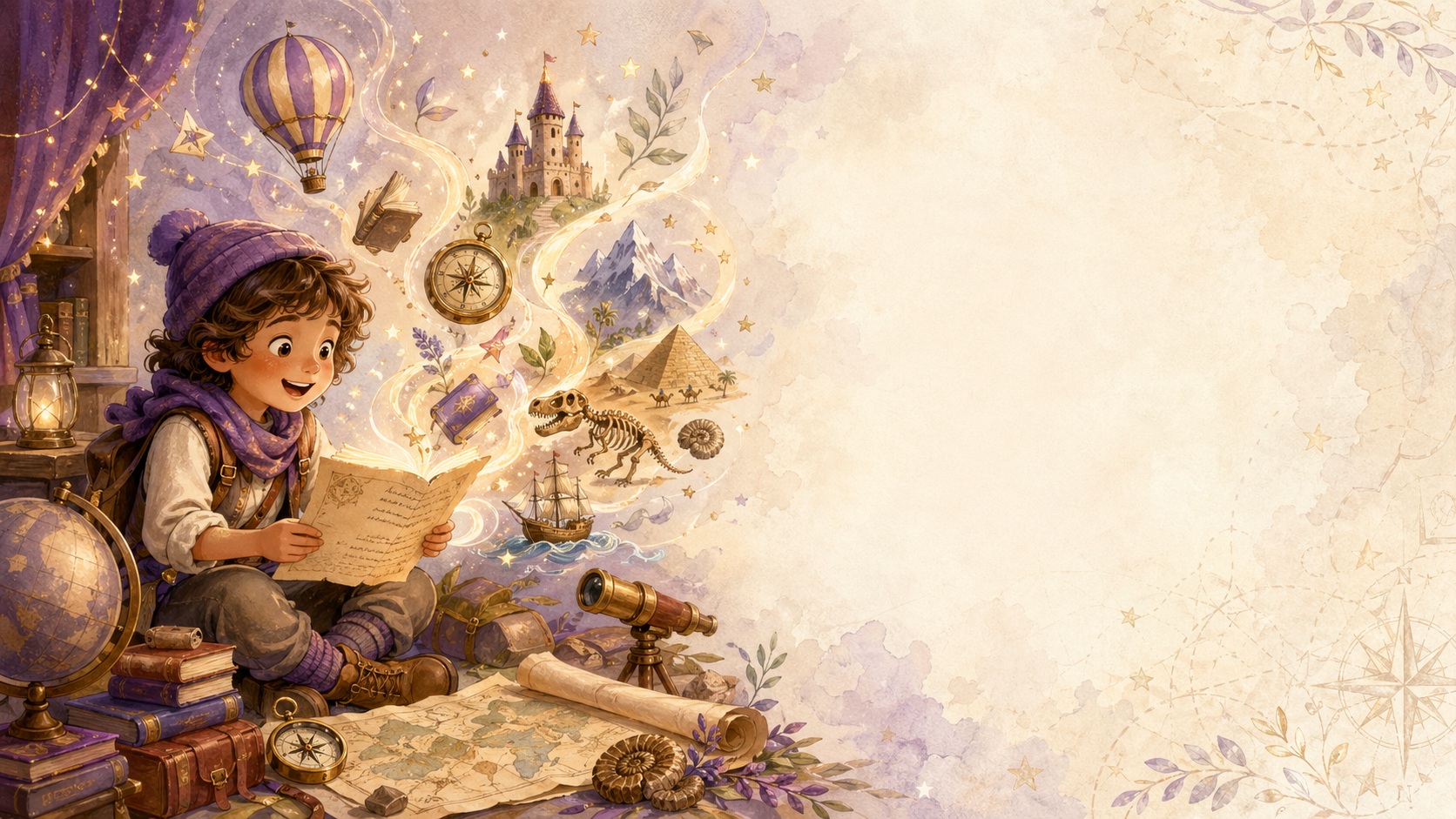
Why Children Learn Better When They Are Curious
Children are naturally curious. They ask questions constantly. Sometimes lovely questions, like “Why is the moon following us?” Sometimes deeply inconvenient questions, like “Why does that man have no hair?” in a queue full of witnesses.
That curiosity is powerful.
When children are interested in something, they absorb information far more naturally. They want to know more. They want to explore. They want to discover how things work, where things came from, and what might happen next.
The problem is that learning does not always feel exciting. Sometimes it feels like homework. Sometimes it feels like a page of facts with all the joy surgically removed.
Educational stories for kids can change that.
They take real learning and wrap it inside adventure, mystery, characters, places, and imagination. Instead of saying, “Today we are learning about ancient Egypt,” a story can say, “A hidden chamber has just been found beneath the desert sand.”
Same learning. Much better doorway.
Learning Through Stories Feels Natural
Children have always learned through stories.
Before worksheets, apps, and online quizzes marched into existence, stories helped people understand the world. Stories taught lessons, history, values, danger, courage, kindness, nature, and how not to annoy the local dragon, depending on the village.
Learning through stories works because it gives information meaning.
A child is more likely to remember something when it is connected to a character, a place, a problem, or an adventure. Facts on their own can feel flat. Facts inside a story become part of something bigger.
A child might not remember a list of dates.
But they may remember a young explorer discovering an ancient tomb, following a silk road caravan, or decoding a message hidden inside a castle wall.
That is the magic of story-based learning.
Educational Stories Make Facts Feel Exciting
There is nothing wrong with facts. Facts are useful. Facts are how we know giraffes exist and adults need coffee.
But facts need context.
Educational adventure stories give facts a reason to matter. They help children see how information fits into a world.
A story about Ancient Egypt can introduce pyramids, pharaohs, hieroglyphs, archaeology, the Nile, and burial customs through mystery and discovery.
A story about the Silk Road can explore trade, geography, cultures, spices, inventions, and ancient travel through a journey across deserts and cities.
A story about the ocean can teach children about tides, sea creatures, navigation, weather, and conservation through a treasure hunt or rescue mission.
The child is learning, but they are also imagining, predicting, questioning, and caring about what happens next.
That is a far better combination than “read page 14 and answer the questions,” which has probably crushed more curiosity than it deserves credit for.
Adventure Gives Children a Reason to Keep Reading
Educational stories for kids work especially well when they are built around adventure.
Adventure creates movement. Something is happening. A character needs help. A map must be followed. A mystery must be solved. A strange object must be understood. A journey must be completed.
This gives children a reason to keep reading.
They are not just reading to collect information. They are reading because they want to know what happens.
Will the explorer find the lost city?
Can the young scientist solve the strange woodland mystery?
What does the symbol on the old letter mean?
Where does the map lead?
When learning is connected to questions like these, it becomes much more engaging.
The child keeps reading because curiosity is pulling them forward.
Stories Help Children Remember What They Learn
One of the biggest strengths of learning through stories is memory.
When information is connected to emotion, imagination, and sequence, it is easier to remember. A child may recall a historical fact because it appeared during a dramatic moment in the story. They may remember a scientific idea because it helped solve a problem. They may remember a place because the characters travelled there.
Stories give learning hooks.
A map.
A clue.
A character.
A challenge.
A discovery.
These hooks help children hold onto new ideas.
Instead of learning feeling like a pile of loose facts, it becomes a journey with shape and meaning.
Educational Stories Can Build Confidence
Some children feel nervous about learning. They may worry about getting answers wrong, falling behind, or not understanding something quickly enough.
Educational adventure stories can help remove some of that pressure.
In a story, learning is not presented as a test. It is part of the adventure.
The child can learn alongside the character. They can make guesses, spot patterns, solve clues, and explore new ideas without feeling judged.
This is especially helpful for children who are reluctant learners or who switch off when something feels too school-like.
A story can quietly introduce knowledge in a way that feels safe, playful, and achievable.
No red pen. No pressure. No adult hovering nearby with the expression of someone trying to be encouraging but accidentally looking terrifying.
Just a story, an adventure, and something new to discover.
Learning Without Making It Feel Like Homework
The best educational stories do not announce themselves too loudly.
They do not stop every two paragraphs to say, “Now, children, here is an important learning point.” That is how you make a child stare out of the window and mentally become a pigeon.
Instead, the learning is woven into the story.
A character might explain something because it helps solve a mystery. A map might show where a journey takes place. A clue might require the child to understand a symbol, a word, a place, or a historical detail.
The educational part feels useful because it belongs inside the adventure.
That is the key.
When learning helps the story move forward, children are much more likely to enjoy it.
Why Interactive Elements Make Learning Even Better
Educational adventure stories become even more powerful when they include interactive elements.
Children might be invited to decode a message, colour a map, solve a riddle, match symbols, follow coordinates, complete a mini activity, or write their own ending.
These activities support learning without making it feel separate from the story.
For example, instead of giving a child a plain geography worksheet, a story might ask them to trace a route across an ancient trade map.
Instead of giving them a vocabulary list, the story might ask them to decode words from a mysterious letter.
Instead of explaining archaeology in a dry paragraph, the story might invite them to help examine a discovered object.
Same knowledge. Better experience. Humanity survives another educational crisis.
Personalised Educational Stories Feel More Meaningful
Personalised stories can make educational learning feel even more exciting.
When a child receives a letter addressed to them, inviting them into an adventure, the learning feels personal. The child is not just reading about a journey. They are being asked to take part.
This can make the experience much more memorable.
A personalised educational letter might invite a child to help an archaeologist, follow a map, solve a mystery, explore a faraway land, or discover how people lived in the past.
The child becomes part of the learning.
They are not just a reader.
They are an explorer, assistant, code-breaker, map-reader, problem-solver, or brave companion.
That sense of involvement can turn learning from something passive into something active and exciting.
Educational Stories Support More Than School Learning
Educational adventure stories do not only help with facts and subjects.
They can also support wider skills, such as:
Curiosity
Problem-solving
Reading confidence
Empathy
Imagination
Creative thinking
Focus and attention
Understanding the world
Learning through stories gives children a richer experience because it combines knowledge with emotional connection and imagination.
A child may learn about history, geography, science, culture, nature, or language, but they are also learning how to wonder, question, and think.
And those skills matter far beyond school.
How Legendary Letters Makes Learning Feel Like an Adventure
At Legendary Letters, educational storytelling is designed to feel magical, personal, and exciting.
Through The Explorer’s Series, children can travel through history, geography, culture, and discovery through story-led letters sent through the post.
Instead of handing children a dry lesson, each letter invites them into an adventure. They might follow clues, meet characters, explore ancient places, solve puzzles, and discover fascinating facts along the way.
The aim is simple:
Make learning feel like a story worth opening.
Because when a child is excited to read, they are far more open to learning.
Perfect for Curious Children
Educational stories for kids are ideal for children who love asking questions, exploring new places, solving mysteries, or discovering how the world works.
They are also wonderful for children who may not usually enjoy traditional learning.
A child who rolls their eyes at homework might still love receiving a mysterious letter from an explorer.
A child who avoids fact books might still enjoy helping a character solve a historical puzzle.
A child who says they do not like learning may simply need learning to arrive wearing a cloak, carrying a map, and asking for their help.
Honestly, fair enough.
Final Thoughts
Educational adventure stories help children learn without making it feel like homework.
They turn facts into discoveries, lessons into journeys, and reading into an experience full of curiosity and imagination.
Through story-based learning, children can explore history, geography, science, culture, and emotions in a way that feels natural, exciting, and memorable.
The best educational stories do not make children feel like they are being taught.
They make children feel like they are discovering something.
And that is where real learning begins.
Suggested Call to Action
Help your child discover the joy of learning through stories.
Explore The Explorer’s Series from Legendary Letters and find educational adventure stories designed to make reading, discovery, and imagination come alive.